M-Hive
Status:
R&D
Year:
2017-2018
Type:
Future Scope
Size:
4000 m²
Client:
UIA Competition
Location:
Mars
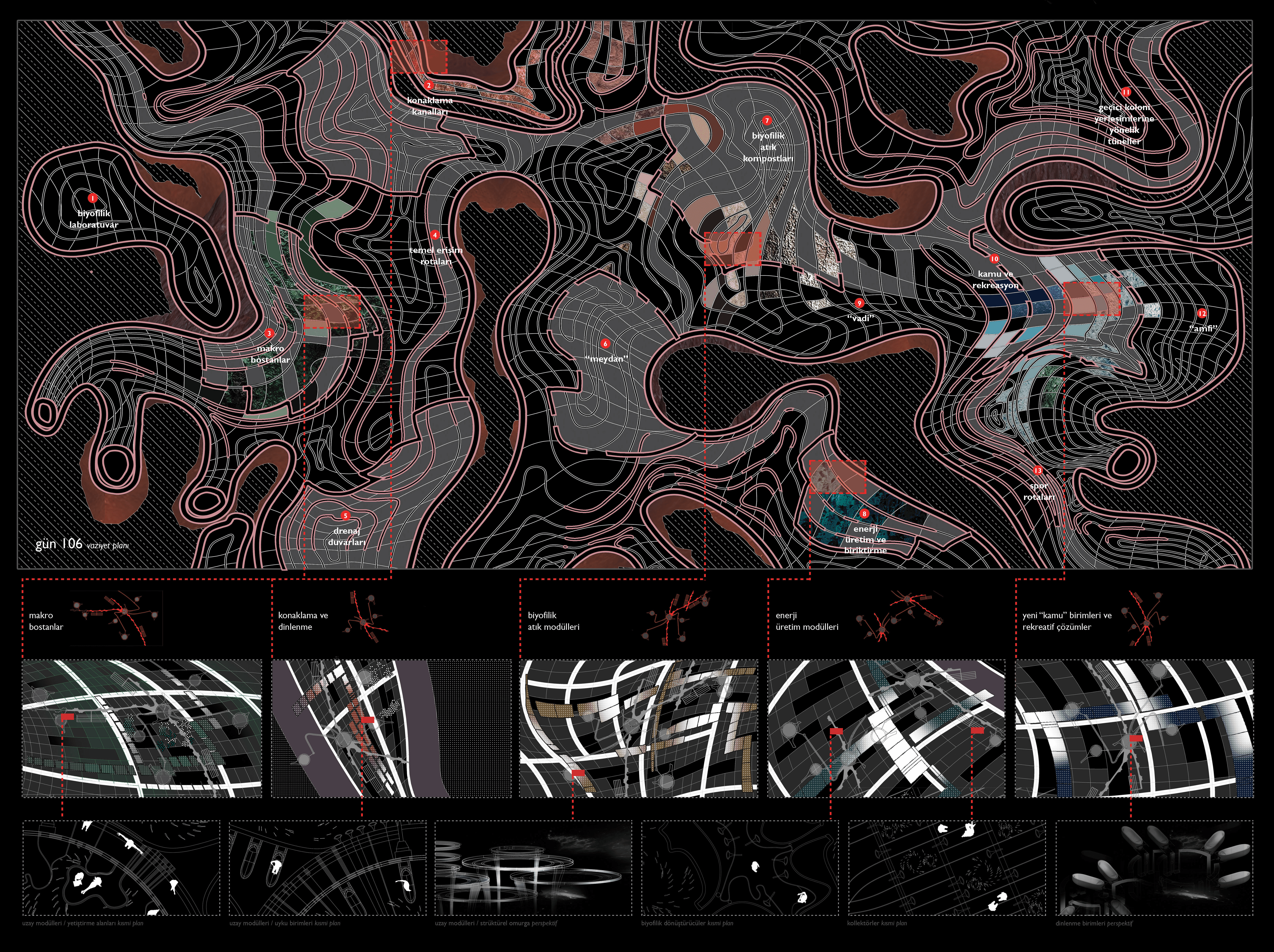
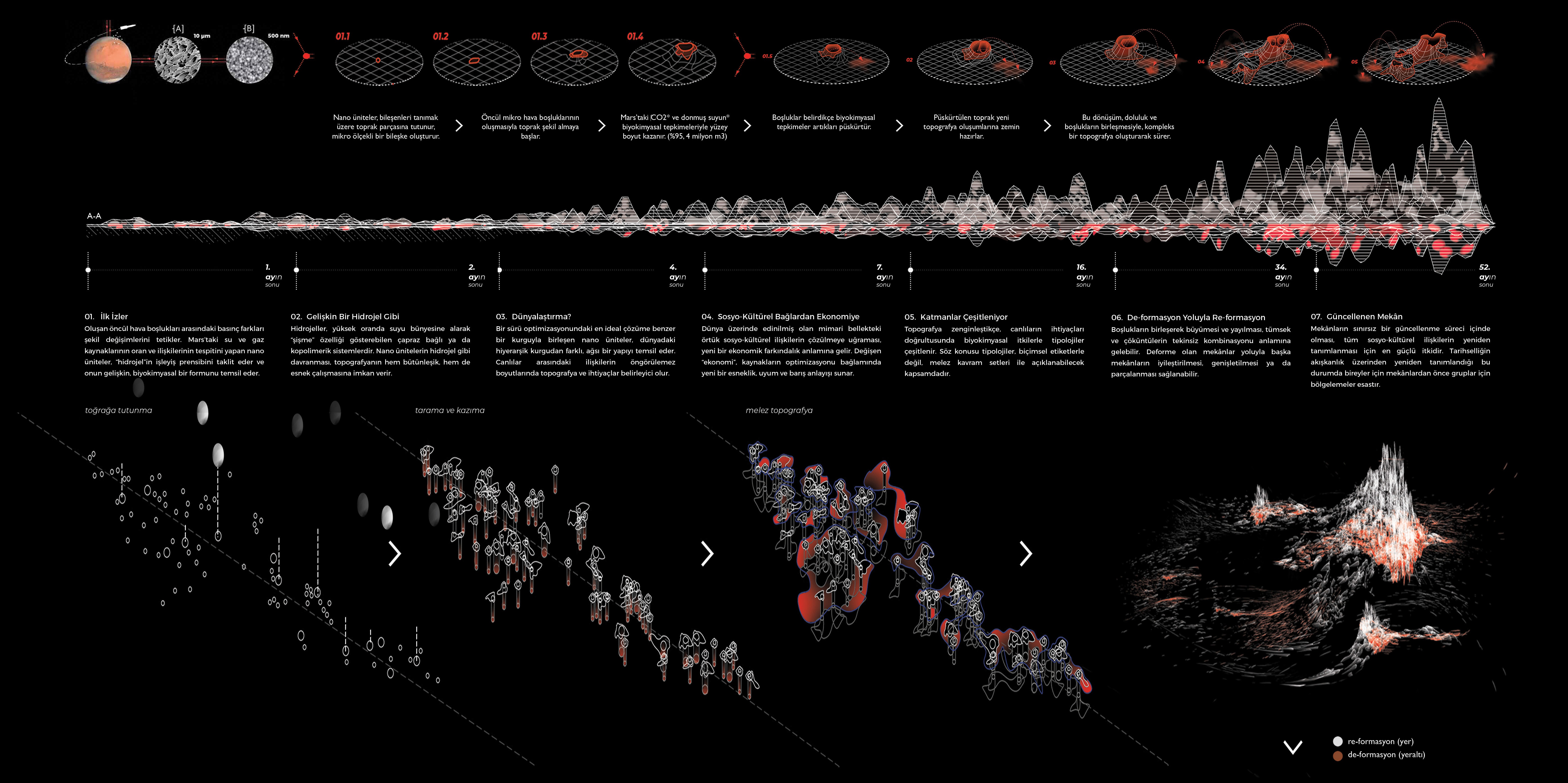
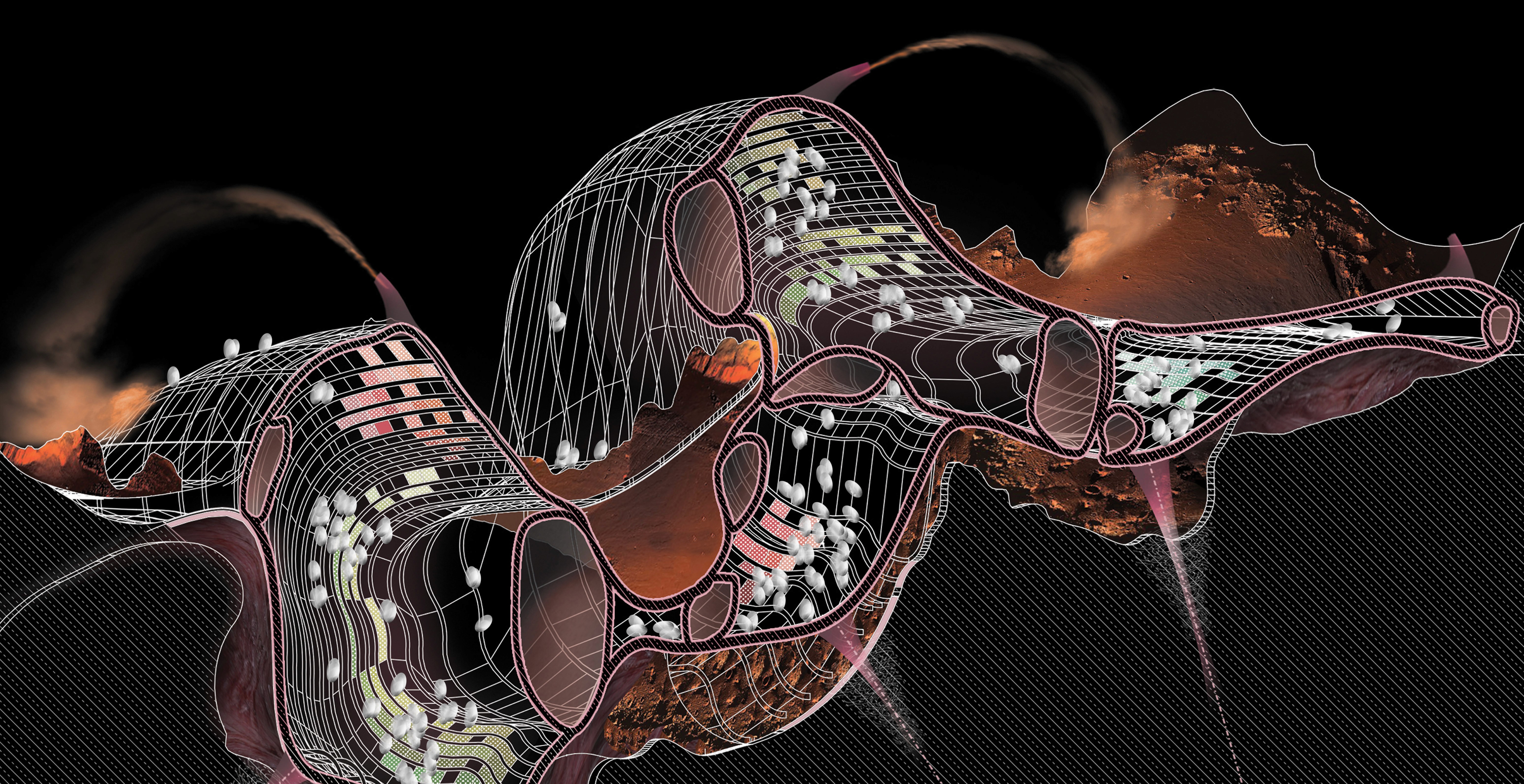
M-HIVE proposes a fundamentally alternative paradigm for extraterrestrial habitation, operating at the intersection of synthetic biology, distributed autonomous systems, and planetary-scale environmental design. Conceived as a self-deploying bio-organic infrastructure, M-HIVE transforms the Martian subsurface into an evolving matrix of micro-habitation units. Rather than importing structural logics from Earth, the system reinterprets colonization as a co-productive relationship between engineered organisms and the mineralogical conditions of Martian regolith.
Upon activation, each M-HIVE module initiates a multi-phase exploratory behavior, sensing density gradients, void patterns, and thermal discontinuities within the soil. These biohybrid agents do not excavate in the conventional mechanical sense; instead, they perform an ecological negotiation with the substrate, selectively softening, binding, or reorganizing particles through controlled enzymatic and biomineralization pathways. This process yields a distributed constellation of micro-voids—incipient life chambers—that gradually aggregate into a clustered superstructure.
Central to the system is its capacity for adaptive morphogenesis. M-HIVE modules communicate chemically and through low-frequency vibrational signaling, enabling a form of decentralized intelligence reminiscent of eusocial insect colonies and mycelial networks. As modules proliferate, retreat, fuse, or differentiate, the emergent architectural fabric becomes a record of collective decision-making under extreme environmental constraints. Each micro-hub is produced through local optimization—radiation shielding, thermal buffering, and structural anchoring—resulting in spaces that are biologically fine-tuned to Martian conditions rather than engineered against them.
The resulting habitat clusters occupy a unique spatial regime: neither fully subterranean nor exposed, but suspended within transitional strata where environmental gradients are most negotiable. Here, the capsules form adaptive envelopes capable of adjusting porosity, density, and metabolic activity in response to circadian temperature cycles and seasonal dust dynamics. Over time, the network becomes increasingly complex, with older chambers mineralizing into stable load-bearing shells while newer, softer units remain metabolically active, maintaining the system's capacity for growth and recalibration.
M-HIVE reframes Martian settlement as a slow, iterative, quasi-biological unfolding rather than a top-down infrastructural imposition. It dissolves the distinction between organism and architecture, treating space-making as a planetary metabolic function. The colony is not constructed but cultivated: a living infrastructural ecology whose expansion is governed by environmental feedback loops and interspecies negotiation.
In this sense, M-HIVE is less a building system and more a planetary adaptation engine. It suggests a future in which human presence is embedded within a responsive, evolving, and partially autonomous biological matrix. The architecture that emerges is contingent, mutable, and inherently local—an outcome of the intimate dialogue between engineered life and the mineral body of Mars.
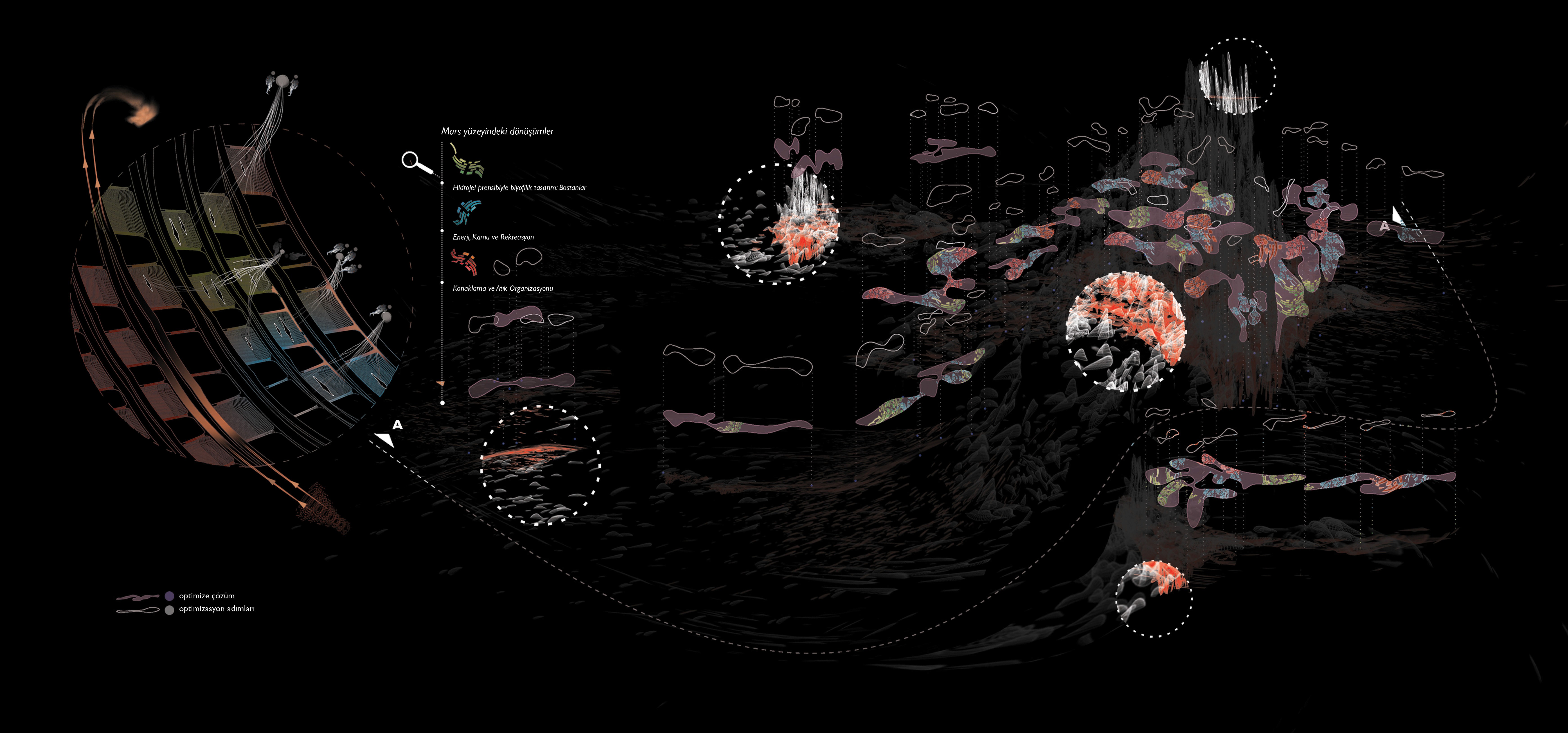
M-HIVE proposes a fundamentally alternative paradigm for extraterrestrial habitation, operating at the intersection of synthetic biology, distributed autonomous systems, and planetary-scale environmental design. Conceived as a self-deploying bio-organic infrastructure, M-HIVE transforms the Martian subsurface into an evolving matrix of micro-habitation units. Rather than importing structural logics from Earth, the system reinterprets colonization as a co-productive relationship between engineered organisms and the mineralogical conditions of Martian regolith.
Upon activation, each M-HIVE module initiates a multi-phase exploratory behavior, sensing density gradients, void patterns, and thermal discontinuities within the soil. These biohybrid agents do not excavate in the conventional mechanical sense; instead, they perform an ecological negotiation with the substrate, selectively softening, binding, or reorganizing particles through controlled enzymatic and biomineralization pathways. This process yields a distributed constellation of micro-voids—incipient life chambers—that gradually aggregate into a clustered superstructure.
Central to the system is its capacity for adaptive morphogenesis. M-HIVE modules communicate chemically and through low-frequency vibrational signaling, enabling a form of decentralized intelligence reminiscent of eusocial insect colonies and mycelial networks. As modules proliferate, retreat, fuse, or differentiate, the emergent architectural fabric becomes a record of collective decision-making under extreme environmental constraints. Each micro-hub is produced through local optimization—radiation shielding, thermal buffering, and structural anchoring—resulting in spaces that are biologically fine-tuned to Martian conditions rather than engineered against them.
The resulting habitat clusters occupy a unique spatial regime: neither fully subterranean nor exposed, but suspended within transitional strata where environmental gradients are most negotiable. Here, the capsules form adaptive envelopes capable of adjusting porosity, density, and metabolic activity in response to circadian temperature cycles and seasonal dust dynamics. Over time, the network becomes increasingly complex, with older chambers mineralizing into stable load-bearing shells while newer, softer units remain metabolically active, maintaining the system's capacity for growth and recalibration.
M-HIVE reframes Martian settlement as a slow, iterative, quasi-biological unfolding rather than a top-down infrastructural imposition. It dissolves the distinction between organism and architecture, treating space-making as a planetary metabolic function. The colony is not constructed but cultivated: a living infrastructural ecology whose expansion is governed by environmental feedback loops and interspecies negotiation.
In this sense, M-HIVE is less a building system and more a planetary adaptation engine. It suggests a future in which human presence is embedded within a responsive, evolving, and partially autonomous biological matrix. The architecture that emerges is contingent, mutable, and inherently local—an outcome of the intimate dialogue between engineered life and the mineral body of Mars.
Project team:
S&A
Building physics:
S&A
Honors:
13rd International Young Architects Meeting, 3rd Prize
(Other works)